Know someone planning a yard project?
The short answer
There is no single dependable lifespan for every French drain. A pipe can remain intact while its collection trench or outlet stops working. Useful life depends on the original design, soil compatibility, sediment control, installation and access for maintenance. An age-based replacement rule is less useful than finding the point where water stops moving.
- Look for a buried, damaged or obstructed outlet.
- Clear accessible leaves and surface debris from collection points.
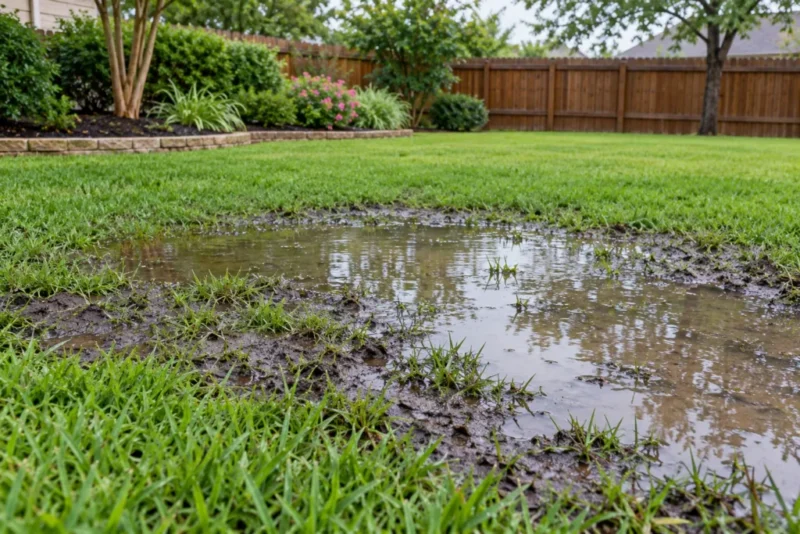
- Record which areas remain wet and when the problem began.
- Have a drainage professional assess pipe condition, elevations and the collection assembly.
Why clay-related clogging is not just a pipe problem
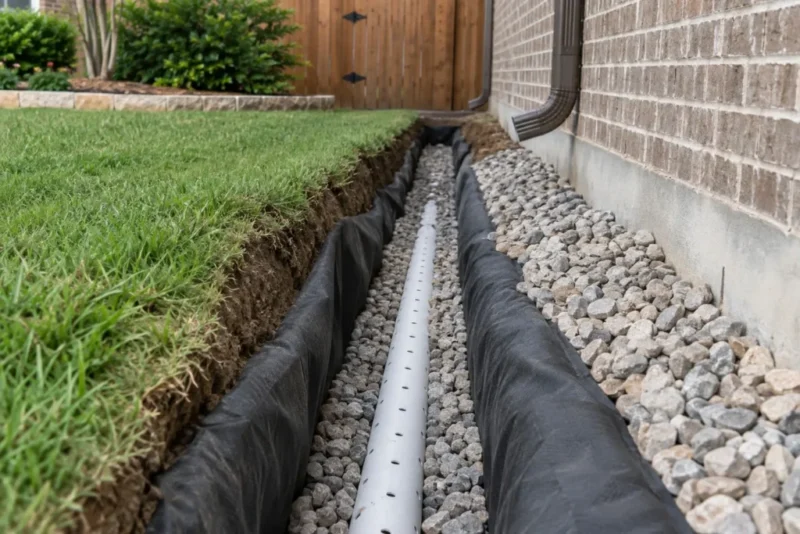
Fine soil particles can move into drainage materials when separation and filtration are poorly matched to the surrounding soil. Roots, construction debris and sediment from surface runoff can also reduce performance. The aggregate, filter design, pipe and outlet function together; a generic fabric wrap is not a guarantee against clogging.
| Symptom | Possible explanation | What the assessment should resolve |
|---|---|---|
| One inlet backs up | Local debris or a restricted branch | Location and extent of the obstruction |
| All collection points back up | Outlet blockage, capacity problem or poor fall | Whether water has a viable route out |
| Pipe flows but nearby ground stays wet | Water is not entering the collection assembly | Trench condition and suitability for the source |
| Problem began after landscaping | Buried access, crushed pipe or altered runoff | What changed and how it affects the system |
If the original system cannot discharge effectively, compare flat-lot drainage and sump-pump options before paying for repeated cleaning.
Find out what system you actually own
Before arranging cleaning, gather the original proposal, route sketch and installation photos. Identify whether the system collects surface runoff, subsurface water or both, and whether it relies on gravity or a pump. A buried opening should not be assumed to be a cleanout simply because a hose fits inside it.
If records are missing, ask the service provider to identify accessible components and explain what remains unknown. Note which part of the yard is wet and whether the entire system has changed or only one branch. That distinction helps target the investigation and avoids paying to clean unrelated pipe.
When flushing helps—and when it does not
Cleaning may remove material from a serviceable pipe, but it cannot repair a collapsed section, correct an uphill run or restore every clogged trench. Before high-pressure cleaning, identify the pipe material, condition, access points and destination of the loosened material. Fragile or damaged pipe may need a different approach. A camera inspection can help where the pipe size and access allow it.
Avoid pushing a garden hose into an unknown opening and assuming the water disappearing proves the system is fixed. It may be leaking into the ground. Ask the technician to explain how performance will be checked after cleaning and what evidence supports any recommendation to excavate.
Use the symptom to choose the inspection
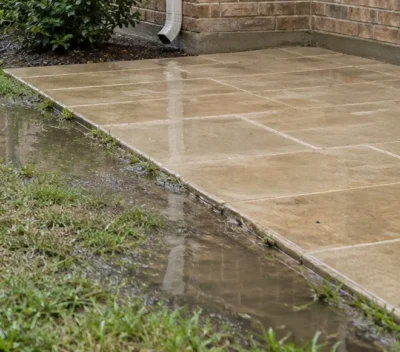
If the system previously worked and one inlet now backs up, local obstruction is a useful starting question. If several areas deteriorated after a new patio or raised bed, investigate the changed runoff and any buried access. If the yard has never drained satisfactorily, the original design and outlet deserve review as well as cleaning.
Ask what each proposed inspection can establish. A camera may reveal a pipe obstruction or damage where access and pipe size permit. It cannot, by itself, prove that water can move through the surrounding soil and filter assembly. A clear internal pipe image is useful evidence, but it is not a complete performance test for a French drain.
A practical maintenance rhythm
Check accessible inlets and outlets after major storms, leaf fall and nearby construction. Keep a route sketch and photographs from installation. Do not plant over cleanouts or allow new mulch and soil to bury them. If your system includes a pump, follow its maintenance instructions as well as caring for the drains feeding it.
Agree on a cleaning outcome before work begins
Clarify which sections will be cleaned, how loosened material will be handled and how the technician will check the result. Ask what happens if inspection finds damaged pipe or inaccessible sections. Those findings may change the method or require a repair quote rather than continued cleaning.
Keep before-and-after observations. A brief flow check can demonstrate part of the route, while later rain shows whether collection in the problem area improved. If the pipe is clear but the ground remains wet, return to the source and trench design. Repeating the same cleaning without new evidence may leave the real limitation untouched.

Repair or replace?
A localized damaged section may justify a targeted repair. A system with no workable outlet, unsuitable elevations or widespread collection failure may require redesign. Ask for the reason in writing, together with the proposed access points, restoration and maintenance plan. Compare a cleaning quote with a replacement quote only after you understand what each is expected to solve.
For French drain inspection and repair in Plano, provide the approximate installation date, any drawings and photos of the problem during rain. Review outlet planning before assuming that new pipe alone will solve recurring wetness.
Keep a simple drainage maintenance record
Store the route drawing, service dates, findings and repair photos in one place. After landscaping, check that access points remain visible and outlet elevations have not changed. Photograph newly installed beds or paving near the route so future changes can be traced.
Do only accessible checks that can be performed safely from the surface. Leave excavation, powered cleaning and pump electrical work to the appropriate provider. A useful maintenance plan states what you can observe, what requires service and which symptoms deserve a prompt call. It should be tailored to the actual system rather than a blanket promise that annual flushing prevents every failure.
Common questions
How many years should a French drain last?
There is no reliable single answer for every installation. Assess collection, pipe condition, outlet and performance rather than relying only on age.
Does flushing remove clay from the gravel trench?
Cleaning the pipe does not necessarily restore a clogged surrounding collection or filter assembly.
Is standing water proof the pipe collapsed?
No. Blockage, outlet conditions, changed runoff, insufficient capacity and poor collection can produce similar symptoms.
Should I replace the whole system?
Ask for evidence identifying the failed component. A localized repair and a complete redesign solve different problems.
Sources and further reading
These references support the technical principles in this guide. Planning examples and checklists are editorial guidance, not a site-specific design.
Plano Development Services · NDS: Principles of Exterior Drainage, including inspection and debris maintenance
Before booking drain maintenance
Locate accessible inlets, outlets and any cleanouts without opening unsafe or buried components. Record what changed, when the system last worked and whether the outlet is blocked or submerged.
What should I gather before requesting a quote?
Send photos of accessible components and the wet area, installation records if available, and any history of flushing or repairs. Ask for diagnosis before high-pressure cleaning or replacement.
Know someone planning a yard project?