Know someone planning a yard project?
Pet turf can work well. It still needs care.
Artificial grass is worth considering for a worn dog run or a yard where you want less exposed soil. Compare the complete system: surface, base, drainage and maintenance. Dogs still leave waste behind, and replacing grass doesn’t remove that responsibility.
Before comparing samples, picture a normal week. How many dogs use the space? Do they have one favorite toilet spot? Can you reach it with a hose? Who will clean it when you’re away? Those answers matter more than choosing the softest sample first.
A promising fit
A defined area with convenient cleaning access, an assessed drainage route and an owner willing to maintain it. You want less mowing there and accept the care that replaces it.
Solve this first
The yard already ponds, the dog run has no practical water access, or you expect an odor-free surface without cleaning. Resolve those constraints before buying turf.
This guide covers residential planning. A boarding facility, daycare or shared apartment dog area needs a maintenance and sanitation plan matched to much heavier use.
Before choosing the finished turf, review base preparation and drainage on North Texas clay.
Follow the water all the way through.
“It drains quickly” should start a conversation, not end it. Ask what happens after liquid passes through the turf. A backing specification alone can’t tell you how a finished yard will perform.

Through the surface
Identify the proposed backing and how it passes liquid. Ask whether the product is intended for concentrated pet use and what its care instructions require.
Through the installation
Ask how the base, site grade and any drainage components work together. Show the installer low spots and where rainwater already collects.
K9Grass describes backing drainage and, in certain applications, a sloped surface beneath the grass that carries rinse water to a drain. That illustrates why the installation matters alongside the product; it isn’t a specification for every yard.
Source: K9Grass system FAQs.
A wet Plano side yard needs an assessment.
Bring photos taken after rain. Note how long water remains, whether downspouts discharge into the space and whether paving traps it. Ask for drainage work to be listed separately so you can see what the estimate addresses.
Don’t assume drilling extra holes in installed turf will solve a problem underneath it. Start with the installer and the system specification. A French drain isn’t automatically the answer either; its route and discharge need to make sense for the property.
 Does the yard stay wet?
 Replacing an irrigated lawn?
Cleaning isn’t disposal by hose. Collect solid waste first. EPA explains that runoff can carry pet waste into waterways, including through storm drains. Ask how runoff will be managed rather than intentionally washing waste toward the street.
Source: EPA pet waste management (PDF).
Include the destination of rinse water and runoff in the drainage conversation: review outlet planning.
A cleaning routine you can actually follow
Use this as a planning checklist, then follow the instructions for your exact turf, infill and cleaner. One dog occasionally using a large lawn and several dogs using a small toilet area should not automatically have the same schedule.
On smaller screens, scroll the table sideways.
| When to check | What to do | What to notice |
|---|---|---|
| After solid waste | Pick it up promptly; follow the product instructions for residue. | Do not wash the whole mess through the turf. |
| Regularly, based on use | Inspect favorite toilet spots and rinse as directed. | Persistent odor or water lingering after rinsing. |
| During a weekly walk-through | Look for leaves, hair, flattened routes and lifted edges. | Discuss small changes before they spread. |
| After storms or heavy shedding | Check debris and places where drainage has changed. | Photograph pooling to share with the installer. |
| When routine care stops working | Request an assessment before repeatedly changing chemicals. | Record products used, locations and when the issue began. |
SYNLawn lists brushing, debris removal and rinsing as care tasks. It also identifies inspection, infill management and drainage checks as professional maintenance activities. These are manufacturer examples, not a claim that Plano Landscaping supplies that brand or offers ongoing cleaning.
Source: SYNLawn maintenance guidance.
Keep the care sheet with your hose supplies.
Ask for the turf name, infill name if applicable, approved cleaner, dilution, application method and pet re-entry directions. Make it easy for another household member or pet sitter to follow.
SYNLawn’s manual discusses pet maintenance and cleaning agents. Use its instructions only where appropriate for the selected product. A recipe found online isn’t automatically compatible with your backing, infill or warranty.
Source: SYNLawn care manual (PDF).
“For our dogs and this area, what should a normal week of maintenance look like—and what tells us we need help?” Get the answer with the product information.
If it smells, investigate the pattern.
Odor alone doesn’t tell you whether the surface needs routine cleaning or the installation needs attention. Make a few observations before buying another bottle.
On smaller screens, scroll the table sideways.
| What you notice | What to investigate | Next step |
|---|---|---|
| One recurring spot | Is it the favorite toilet area? | Discuss concentrated use and the prescribed routine. |
| Odor plus ponding | Does rain or rinse water linger there? | Document it and request a drainage check. |
| Leaves or hair collecting | Has debris accumulated around edges or traffic lanes? | Use the approved removal method. |
| Smell returns after treatment | Was the cleaner compatible and used as directed? | Share the product name and routine with the installer. |
| Lifted edges or seams | Is the dog pulling at a vulnerable spot? | Keep the dog away from damage and arrange inspection. |
K9Grass’s maintenance guidance explains that removing debris helps prevent hair and waste from slowing drainage and retaining unwanted material. Looking below the blade tips is more useful than judging cleanliness only by color.
Source: K9Grass maintenance guide (PDF).
A deodorizer isn’t proof that a drainage issue has been corrected. Ask what an assessment found and what the planned work changes. Don’t judge a permanent fix only by whether the smell disappears that afternoon.
Plan for the afternoon, not just the showroom.
Think about when your dog actually uses the yard. A surface that looks inviting in a morning photograph may feel different later in direct sun.
Penn State has studied synthetic turf temperatures and cooling through watering. Much of the research concerns sports surfaces, so it can’t predict a specific backyard product’s temperature. It does support treating heat as a real design consideration.
Source: Penn State surface-temperature research.
- Compare samples outdoors under similar exposure.
- Ask about full afternoon sun, not only shaded conditions.
- Provide an alternative shaded area and access back indoors.
- Do not rely on a brief rinse to guarantee comfort for hours.
For “cooling” claims, ask what was tested, under which conditions and what maintenance is needed. Shade can be part of the wider outdoor living plan, but its position should match where the dog spends time.
For a closer look at surface temperature and shade, read how to plan turf for North Texas summer heat.
Compare the system, not “pet-friendly” on a label.
Ask each bidder to name the components. Similar green samples can hide different proposals, and a lower quote may omit work you thought was included.
Surface and backing
Get the product name, planned use, drainage information and care instructions. Ask how seams and edges will be secured near gates or fences where your dog runs or digs.
Infill and preparation
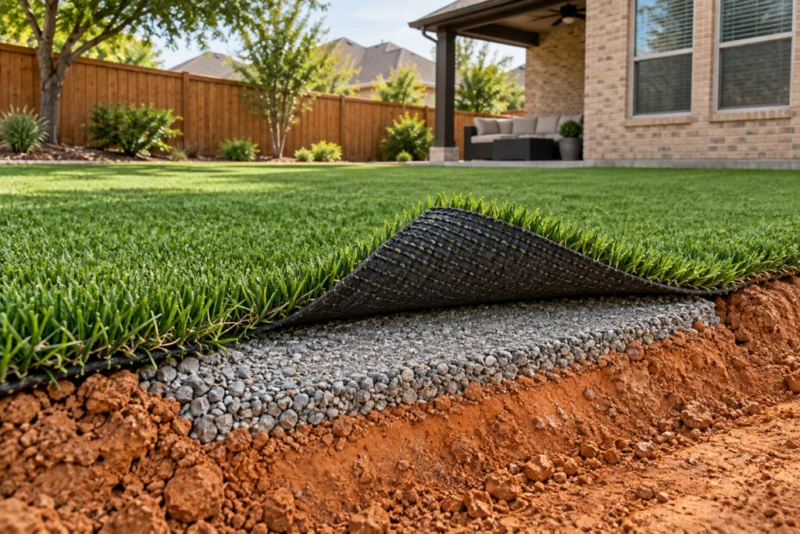
Ask whether this system uses infill, which material is proposed and why. Get the base preparation and drainage scope in writing instead of assuming all pet systems use identical layers.
An odor-control or antimicrobial feature isn’t a promise that the entire yard cleans itself. Ask what the claim covers and what maintenance remains necessary. Read warranty exclusions as well as the headline period.
Still deciding between living grass and turf? Our Artificial Turf vs. Sod guide compares sunlight, ongoing care, cost and other tradeoffs.
A dog run and a family lawn need different plans.

One dog, a larger shared yard
Map the favorite toilet spot, play area and family seating. A defined pet area may be enough; you don’t have to replace every part of the lawn.
Several dogs, a narrow side yard
Explain the concentrated use. Prioritize cleaning access, drainage, edges and a manageable routine. A compact space isn’t automatically the simplest installation.
A yard struggling after rain
Start with the water problem. Compare drainage and surface work together, with an explanation of which issue each item addresses.
Keep water for the plants—and cleaning.
Existing sprinklers may serve beds you want to retain. Discuss which lines need capping or rerouting and how plants will keep receiving water. Preserve convenient hose access: removing lawn irrigation doesn’t mean a pet area never needs water.
Bring these details to your estimate.
A yard photo helps. A photo plus an explanation of how the dogs use it’s better.
- Your address, approximate area and photos from several angles.
- Number and approximate size of dogs, including digging or chewing habits.
- Favorite toilet spots and running routes.
- Photos of standing water after rain.
- Hose location, sprinkler coverage and gate access.
- Sun exposure during the hours the space is used.
- Whether you want a dog run, a shared lawn or both.
Ask the quote to separate removal, preparation, turf, drainage, irrigation changes and access-related work. Include ongoing cleaning supplies or outside maintenance in your ownership budget, even when they’re outside the installation quote.
Plan a pet area around your yard.
Tell Plano Landscaping what is happening now—mud, worn grass, pooling or a space you want to use differently. We can discuss installation and related yard improvements.
Questions dog owners ask
Will artificial grass smell like dog urine?
Odors can occur. Ask for care guidance matched to the system and level of use. Recurring smells, especially with pooling, deserve an assessment rather than repeated masking.
How often should I rinse it?
Follow the selected system’s instructions and discuss your household’s use with the installer. Several dogs using one compact spot need a different plan from occasional use across a larger lawn.
Can I use bleach, vinegar or a pressure washer?
Don’t assume a household recipe or aggressive equipment is suitable. Check the manufacturer’s instructions, cleaner label and warranty. Ask for approved methods and directions for when pets can return.
Does pet turf need a French drain?
Not automatically. Ask for a site-specific explanation of where water goes and whether additional drainage is needed. Explore our yard drainage services for related options.
Can my dog damage the turf?
Discuss digging and chewing before installation. Ask about edge security, repair options and warranty exclusions. Durable doesn’t mean indestructible.
Can it go over concrete?
Treat this as a different installation question. Ask how the system handles slope, liquid movement, edges and cleaning over the existing hard surface. A lawn-base illustration isn’t a specification for concrete.
Do we need to replace the entire lawn?
No. A defined pet area may suit your budget and layout. Compare the dog’s routes, family activities and upkeep of each surface before deciding.
Sources and further reading
Manufacturer guidance is product-specific. These citations aren’t endorsements or confirmation that Plano Landscaping installs those brands. Planning questions and scenarios are editorial guidance; confirm your selected system’s written instructions.
- SYNLawn maintenance guidance
- SYNLawn care manual (PDF)
- K9Grass maintenance guide (PDF)
- K9Grass system FAQs
- Penn State surface-temperature research
- EPA pet waste management (PDF)
Prepared for editorial and business review, October 3, 2026. Illustrations don’t document customer projects.
Explore more Knowledge Hub guides →Know someone planning a yard project?