Know someone planning a yard project?
Pick for the job the surface has to do
Concrete can suit a continuous, simple layout; individual concrete pavers offer patterned layouts and access to individual units; natural stone offers a varied appearance whose performance depends on the particular stone and installation. None is automatically best for every Plano yard.
A driveway carries vehicles. A patio holds furniture and hosts people. A walkway must provide a comfortable route through the yard. Those uses should guide the specification before color or pattern.
Tell the installer about steps, doorways, water movement and any future structure. A surface choice can’t compensate for a poorly planned elevation or unsupported edge.
Carry the material choice through to preparation with our paver patio base guide for DFW clay and concrete stepping-stone and black-DCG path guide.
What changes with each option?
| Question | Poured concrete | Concrete pavers | Natural stone |
|---|---|---|---|
| Appearance | Continuous surface; finish options depend on scope. | Individual units with repeatable patterns and borders. | Variation in color, texture and dimensions by stone. |
| Repair discussion | Ask how a damaged area would be addressed and how repairs may look. | Ask about lifting units and matching replacement stock. | Ask about replacement availability and matching natural variation. |
| Water movement | Requires a drainage plan. | Standard pavers are not automatically a permeable system. | Depends on the complete assembly, not the stone alone. |
| Support | Specification should match the use and site. | Base, bedding, joints and edge restraint work together. | Support and setting method depend on the selected product and use. |
| Quote comparison | Finish, joints, preparation and curing responsibilities. | Exact unit, pattern, edge treatment and installation system. | Exact stone, thickness, finish, setting method and waste allowance. |
This is a decision table, not a ranking of brands or installation methods. Ask for the specific proposed assembly when comparing prices.
When a continuous surface fits the project
If you want a straightforward driveway or patio, start by discussing concrete. Ask what finish is proposed and how the layout handles joints, transitions and drainage. A decorative finish changes the appearance, but the underlying installation still matters.
The American Cement Association’s concrete guidance explains why proper placement, joints and curing are part of durable work. Ask your installer to describe the project-specific approach and when the area can be used.
Don't accept 'concrete cracks' as the full answer to every future problem, or expect a promise that it will never crack. Ask which workmanship problems are covered and how they'll be checked.
Look beneath the individual blocks
Pavers can make a useful choice when pattern, borders or the ability to access individual units matters. But a sample in your hand doesn’t show the base, bedding, edge restraint or joints that support the finished installation.
CMHA’s base guidance explains that loading and site conditions influence the required base. Avoid comparing proposals by one universal depth without discussing what it supports.
Ask whether spare units should be retained for later repairs. Also distinguish standard paving from an intentionally designed permeable system. Visible joints don’t establish that runoff will be managed adequately.
Choose the actual stone, not just the category
“Natural stone” covers a broad range of products. View representative samples, including variation, and ask whether the selected stone and finish suit the planned use. A driveway specification and a pedestrian patio specification aren’t interchangeable.
Discuss thickness, setting method, joint treatment and the feel of the surface underfoot. If the patio connects to a pool or is often wet, ask specifically about the selected finish in those conditions. Don’t assume every stone has the same traction or maintenance needs.
The Natural Stone Institute’s technical library is a resource for product and installation questions. Have the installer identify the applicable product guidance rather than choosing by a photograph alone.
A good surface still needs the right levels

Walk the route from the house to the proposed space. Where does water go now? Are there low spots, steps or thresholds that need to be accommodated? Discuss these before deciding how the finished surface should meet existing work.
For a wet yard, start with drainage assessment. A new patio should not simply cover an unresolved water problem. If irrigation crosses the area, discuss protection or adjustment with the irrigation scope.
Ask to see dimensions and transitions on a simple sketch. You don’t need a decorative rendering to notice that a chair can’t pull out comfortably or that a walkway narrows at a gate.
 Resolve standing waterExplore yard drainage →
 Plan irrigation changesExplore sprinklers & irrigation →
Match the surface choice to the dimensions and route you need: plan walkway width, steps and transitions; test the patio furniture layout.
Compare installed scope and future care
Material price alone leaves out demolition, preparation, hauling, access, drainage and the installation system. Request the same footprint and finish level from each proposal before judging the totals.
Ask about cleaning, joint care, any recommended sealing and the expected approach to repairs. Those answers must be specific to the selected product and installation; there’s no universal “maintenance-free” option.
Our patio cost guide explains the budget categories. For vehicle use, pair this comparison with the driveway estimate checklist.
Three useful starting conversations
- A simple vehicle entrance: compare an appropriate concrete proposal with a vehicle-rated paver system, including the same removal and preparation.
- A patterned entertaining patio: compare paver layouts with the exact stone option you like, including furniture space and transitions.
- A narrow garden route: prioritize a comfortable, stable walking surface and usable width before decorative details.
Bring photos and tell us what bothers you about the existing space. We can discuss driveways, patios and walkways around the way you plan to use the yard.
Plan My Paving Project →Find Your City’s Driveways, Patios & Walkways Permit Resources
Specify the use, material, dimensions and whether this is replacement or expansion. A driveway apron, sidewalk connection and backyard patio can follow different approval paths.
What to ask about this project
Ask about flatwork permits, right-of-way or approach approval, drainage and impervious-cover limits, and required inspections. Describe any street, sidewalk, grade or utility changes rather than only the surface material.
Find your city below. Find official resources for Plano and the DFW / North Texas communities we serve. Each city can have different rules, so check the ones that apply to your address and project.
Neighborhoods and communities
These neighborhoods use their city's resources. Check which city has authority over your property.
Confirm the address, scope and fees
Check which authority covers your property; the mailing city alone may not tell you. Dallas neighborhoods link to Dallas resources. Las Colinas and Valley Ranch link to Irving. Check boundary properties, Heartland and Hebron carefully. For Hebron, use the county-listed town contact to confirm the permitting authority. Ask who handles applications, what the current fees are, and which plans and inspections you need. HOA approval is separate from city approval.
Official resource directory maintained October 4, 2026. General links show you where to ask about permits. They don't confirm whether your work needs one. Check the current rules for your project before work begins.
Material questions homeowners ask
Do pavers solve standing water?
Not by themselves. The complete surface and drainage design need to address where water goes.
Is natural stone always more expensive?
The stone, preparation, installation method and layout all affect the finished price. Compare the actual quotes for your job.
Can I reuse the existing base?
Have its condition and suitability assessed for the proposed system. Don’t assume reuse from appearance alone.
Should I choose the same material everywhere?
It can simplify the visual design, but each area still needs a suitable installation for its use and loading.
Sources and design context
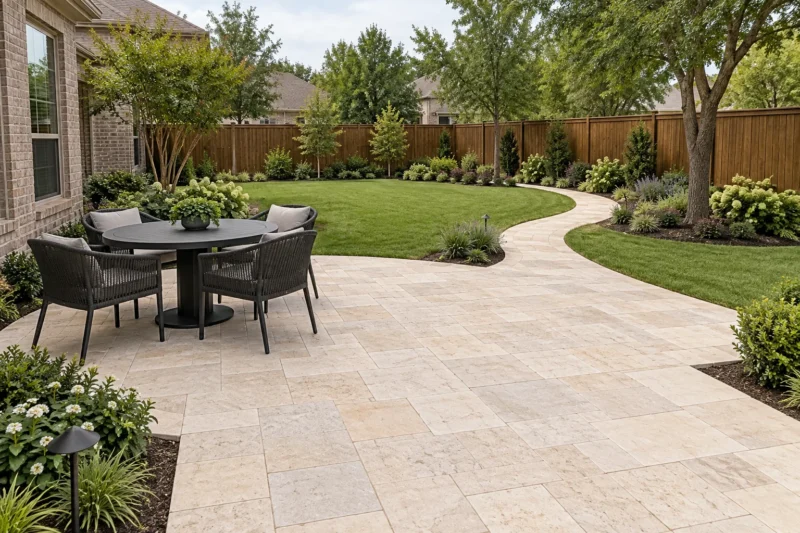
Images and color chips illustrate design possibilities, not exact supplier samples or completed customer projects. Confirm the selected product, support system, drainage, current approvals and care requirements for your site. No universal installation depth, traction rating or maintenance-free performance is established by this guide.
Know someone planning a yard project?