Know someone planning a yard project?
Decide where water goes before deciding what covers the ground
Check how water moves, agree on the finished ground levels and find a suitable outlet before installing the finished landscape. Then coordinate the work that needs excavation or access with the lawn, paving and planting areas that follow.
This is a sequencing guide. If you’re still trying to understand the cause of a wet spot, start with Why Does My Yard Stay Wet? Here, the question is how to keep the project from undoing its own progress.
Tell every contractor about the full plan, even if the work will happen in phases. An isolated patio quote can miss a future drain route; an isolated drain quote can overlook the patio level.
Walk the edges as well as the center
Look at the house-to-yard transition, downspouts, fences, gates and neighboring ground. Identify existing drain inlets and any known outlets. Bring photos from rain events if available.
Mark what is staying and what is changing on a simple sketch. Include irrigation, planned walls and equipment access. The sketch helps coordinate the discussion; it isn’t an engineered drainage design.
Ask how final levels will meet existing surfaces. “Raise the lawn” needs more explanation when doors, foundations, paths and boundary levels constrain the available space.
A practical order to discuss with the installer
| Planning stage | Decision to resolve before moving on |
|---|---|
| Understand the water | Source, route, low points and existing drainage. |
| Define the finished yard | Proposed uses, levels and surfaces. |
| Confirm approvals | Discharge, easements, right-of-way and required plans. |
| Coordinate excavation | Drains, irrigation, foundations and access. |
| Inspect and document | Required checks before buried work is covered. |
| Restore and establish | Preparation, paving or sod, care and handover. |
This sequence is a coordination framework, not a fixed construction schedule. The site and required inspections determine the actual order.
Different finishes still share the same water problem

For sod, discuss lawn preparation and irrigation coverage after the drainage work. Include disturbed access routes, not only the trench.
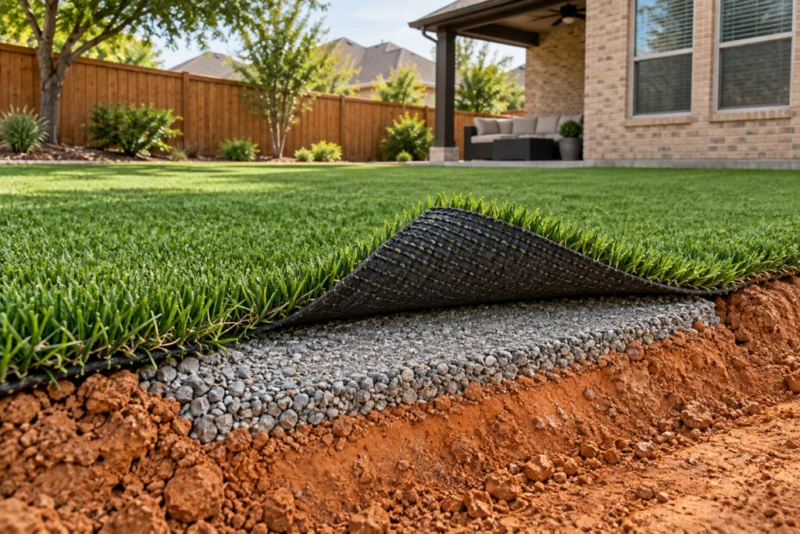
For artificial turf, coordinate the base and outlet arrangement with the drainage plan. Also identify irrigation that needs adjustment or removal while protecting water supply to plants you want to keep areas.
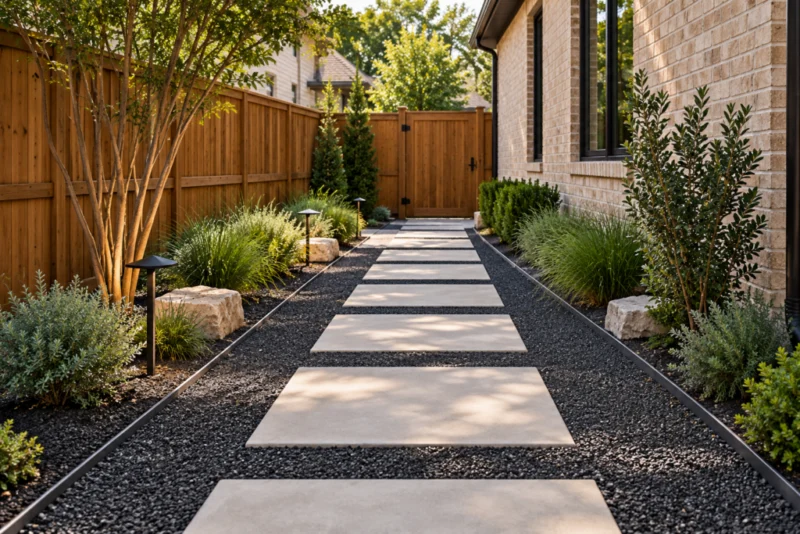
For paving, settle levels and water routes before installation. A new edge or raised surface can change how water crosses the yard.
 Plan the new lawn
 Compare artificial turf
Do not let the border become an accidental barrier
Show the drainage designer where stone borders and retaining walls are planned. A decorative feature still occupies a route water may currently use.
Allan Block’s residential wall guidance emphasizes considering concentrated water sources as part of planning. Its details apply to its wall systems; they aren’t a universal recipe for every stone border.
If the wall holds back soil, ask who is responsible for its design and drainage. Adding a hole through an existing wall isn't automatically the right repair.
Make restoration explicit
Ask the drainage proposal to identify excavation, material removal, installation, outlet work, testing or inspection requirements and final restoration. If another crew handles the sod, define the handoff condition.
Keep irrigation repair separate enough to understand, even if it’s included in the same project. A drain installer and an irrigation provider should not each assume the other will restore a damaged line.
Use our drainage cost guide to organize the budget. A price per foot leaves out access, connections, finish and the solution’s suitability.
Phase finishes without losing the overall plan
If the budget requires stages, decide the final layout now and ask which work must happen together. It may be reasonable to postpone a decorative feature, but not to leave an unresolved excavation or incomplete water route.
Ask whether temporary stabilization and maintenance are needed between stages. Clarify who monitors the area after a rain and what conditions should trigger a follow-up.
Keep photographs of buried routes and handover documents for future projects. They’re useful context, but don’t replace utility locating before later digging.
Plan Drainage Before Landscaping →Check approvals for your project
Confirm the outlet, easements and any grading or public-system connection before excavation.
Sequencing questions
Should drainage always go before sod?
Assess and coordinate necessary drainage before the final lawn installation so new sod doesn’t need to be disturbed unnecessarily.
Can I add a patio later?
Yes, but disclose its intended location and levels now so the drainage plan can account for it.
Does drainage work include lawn restoration?
Only if stated. Identify soil preparation, sod and irrigation responsibilities in the estimate.
Are photographs enough for future digging?
No. Keep records, but arrange appropriate utility locating and site checks before excavation.
Planning basis
Know someone planning a yard project?