
Know someone planning a yard project?
The short answer
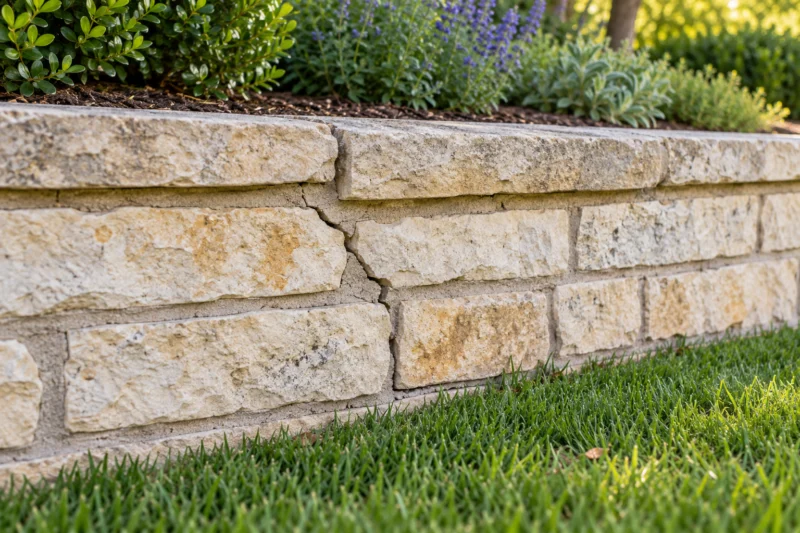
A cracked retaining wall is telling you that something moved or that the assembly could not accommodate its stresses. In North Texas, expansive soil and water deserve attention, but they are not the only possible causes. Foundation support, wall geometry, workmanship, tree roots and added loads may also matter. The visible crack is the starting point for an assessment, not a repair specification.
- ABOVE → runoff, irrigation and added loads behind the wall.
- BEHIND → retained soil, drainage materials and filtration.
- THROUGH → wall units, mortar, joints and any designed outlets.
- BELOW → footing or base and the supporting soil.
Clay movement and water pressure are different mechanisms
Expansive clay can swell when wet and shrink as it dries, changing support conditions. Water trapped behind a retaining wall can also create pressure against it. A drainage plan addresses water management, while the structure must still be designed for the applicable soil and other loads. Adding a drain does not automatically correct inadequate support or an undersized wall.
Compare construction details in our mortared versus dry-stacked stone edging guide; decorative edging and soil-retaining structures need different planning.
Record movement without disturbing the wall
Photograph the whole wall and the relationship to the slope, paving and nearby structures. Then photograph cracks with a simple scale in view and keep dates consistent. Note any visible change in leaning, bulging, joint openings or soil loss. Stay clear of an unstable area and do not dig to expose hidden components yourself.
Tell the assessor when the symptoms appeared and what changed nearby. A new driveway, a raised bed, stored materials or redirected downspout can alter conditions even when the face stone looks unchanged. These observations help guide the assessment; they do not establish a diagnosis or a safe load limit.

What weep holes and gravel actually do
A drainage assembly may use free-draining material, filtration, a collector pipe and suitable outlets. Weep holes can form part of a designed system for some wall types. Gravel without an outlet can still become saturated; open holes are not evidence that the entire assembly works. Retrofitting holes in a distressed wall should follow an assessment rather than an improvised drill pattern.
| Visible clue | Question for the assessor |
|---|---|
| Stair-step mortar cracks | Has support moved, and is movement continuing? |
| Bulging or leaning face | Are soil pressure, water and stability adequately addressed? |
| Washed-out material at the toe | Is erosion removing support or carrying soil through the wall? |
| New patio, driveway or stored materials above | Did added loading change the design conditions? |
Understand the route behind the stone face
A retaining wall manages soil as well as its own weight. The face is only the visible part. Water entering behind it needs a designed route, and the support below must suit the wall and ground. A repair that discusses mortar color but ignores the base and retained side may leave the cause unresolved.
Ask the assessor to explain the proposed drainage path in plain language: where water enters, how soil is kept from migrating where necessary, how water is collected and where it exits. A gravel pocket or a visible weep hole is not a substitute for that complete explanation. Existing outlets also need to remain accessible and functional.
When repointing is too small a repair
Replacing damaged mortar can improve a joint, but it does not solve active foundation movement or inadequate wall stability. Ask whether the crack is cosmetic, whether its cause has been identified and what evidence supports the proposed repair. If movement is active, a patch may conceal the symptom while the cause continues.
Keep people away from a visibly unstable wall and avoid adding loads above it. Do not excavate at the toe or behind it to investigate on your own. A leaning wall supporting occupied areas, a driveway or another structure deserves prompt professional review.
Keep new loads out of a repair assumption
Before repairing, disclose plans for a patio, driveway, shed or other change above the wall. Even temporary stockpiles and construction access can matter. The appropriate professional should determine which loads the design must accommodate rather than assuming the old wall can support the new use.
If a proposal involves rebuilding, ask how excavation and temporary support will be handled around existing features. Access can influence the work as much as the chosen stone. Keep responsibility for engineering, permits where required, drainage and restoration explicit so those items are not left between separate contractors.

Prepare for a useful site visit
Bring approximate age, past repairs, photos showing change over time and any drawings. Note whether the problem worsens after rain or drought. Identify irrigation, downspouts and recent work above the wall. The proposal should address stability, drainage, access, approvals and restoration as connected parts of the project.
For retaining wall assessment and installation in Plano, ask what can be repaired and what needs rebuilding before selecting the face stone. A low decorative border and a wall retaining a meaningful soil height require different decisions.
Compare repairs by the cause they address
Repointing addresses joints. Resetting or rebuilding may address displaced parts of an assembly. Drainage changes address an identified water route. These activities are not interchangeable, and more than one may be needed. Ask why the proposed combination is appropriate and which observations support it.
After work, keep photographs and the written scope. Understand what movement or drainage symptoms should trigger another assessment. A promise that new mortar will never crack in moving soil is less useful than a clear explanation of the repair’s purpose and limitations. Choose the structural and water-management approach before deciding the final visual finish.
Common questions
Are all cracks caused by expansive clay?
No. Support, water, loads, workmanship and other site conditions can contribute. The crack needs context.
Will adding weep holes fix the wall?
Not necessarily. Drainage outlets must fit the wall’s design, and they do not correct every stability or support problem.
Can I just replace the cracked mortar?
Only if the assessment supports that scope. Cosmetic joint work does not resolve active movement or inadequate stability.
When should I keep people away?
Visible leaning, bulging, falling material or other signs of instability warrant keeping clear and seeking professional review.
Sources and further reading
These references support the technical principles in this guide. Planning examples and checklists are editorial guidance, not a site-specific design.
CMHA: Segmental Retaining Wall Design · Foundation Performance Association: expansive soils · Plano building codes
Before a retaining-wall assessment
Photograph the whole wall, the visible crack or lean, the ground above it and any drainage outlets. Note when movement appeared and any recent changes to water, soil or loading.
What should I gather before requesting a quote?
Provide wall dimensions, access limits and any drawings or repair history. A cosmetic mortar repair is not evidence that the retained soil and drainage have been assessed.
Know someone planning a yard project?


