The short answer
Artificial turf can cover the lawn, but it cannot make an unsuitable base or trapped water disappear. On a clay site, evaluate the existing surface, soil support, finished levels and water route before selecting the turf product. The written quote should explain the assembly beneath it and how water leaves—not only its pile height and color.
Start with the problem beneath the old lawn
A shaded yard may be thin because the grass lacks light. A pet route may be worn because the same small area takes repeated traffic. A soft patch can have a water or support problem. Artificial turf changes the surface and the maintenance routine; it does not prove the cause of the original problem has been removed.
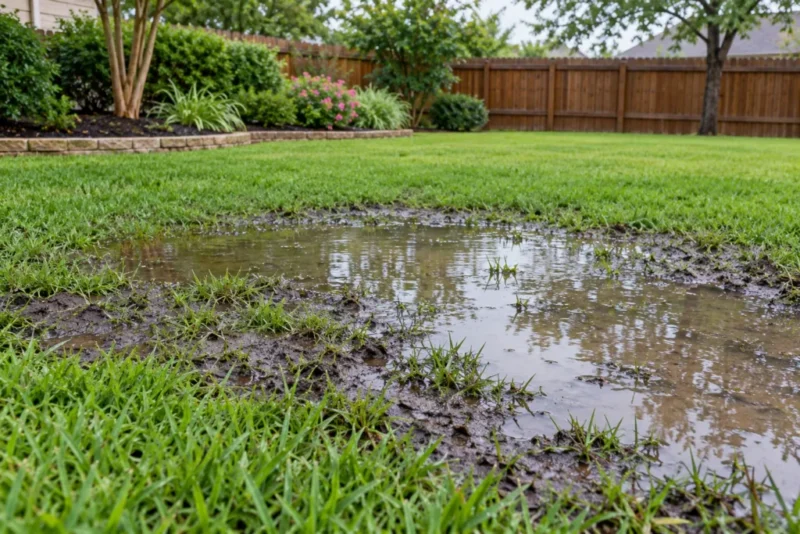
Photograph conditions after rain and describe everyday use before choosing a product. Include downspouts, low points, irrigation, tree roots and where water currently leaves. This article addresses installation planning. Use our turf-versus-sod comparison if you are still deciding which surface fits the household.
Ask what happens to the existing grass
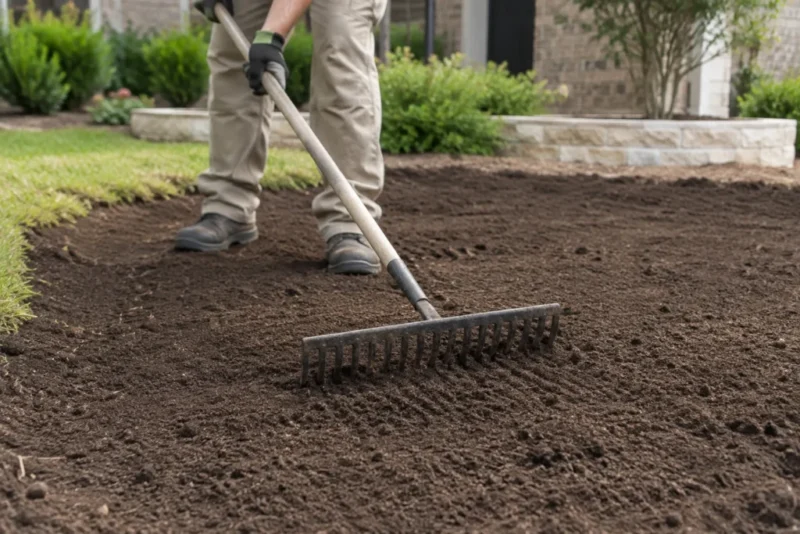
The preparation should identify the vegetation being removed, excavation and disposal. Where persistent Bermuda or weeds are present, ask how regrowth risk will be managed. Do not assume a thin fabric layer eliminates every living runner or seed. A material described as weed barrier is only one possible component, with a specific role and installation requirements.
Clarify the treatment and removal sequence with the installer. Do not borrow the sod conversion schedule automatically: product labels, the selected turf system and site conditions still govern preparation. Ask whether treatment is needed and whether it is included in the turf quote. The sod pretreatment policy on our separate lawn-conversion guide is not a blanket promise for every turf contract.

Read the installation as a complete assembly
- Turf & infillSelect for use, comfort, cleaning and warranty terms.
- Finishing layer & baseSpecify compatible aggregate and support.
- SubgradeAssess stability, moisture and unsuitable material.
- Water destinationExplain infiltration, collection or another suitable route.
Planning sequence; the assessment determines the work.
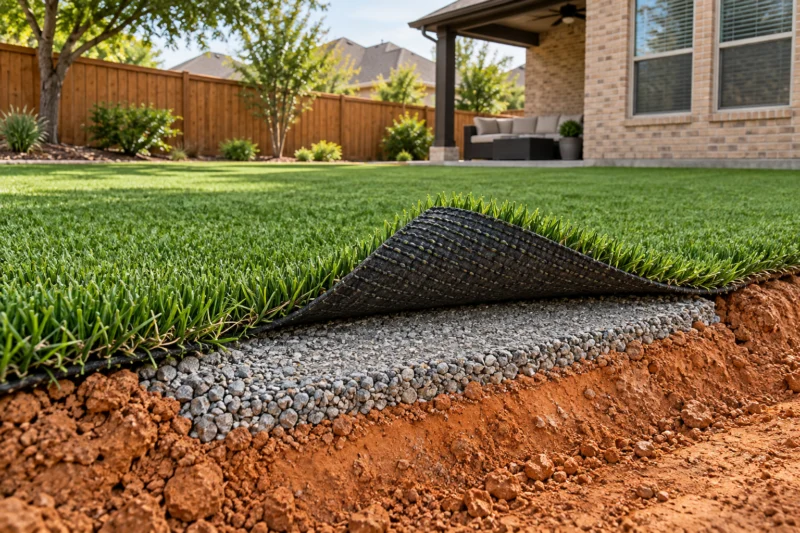
The selected turf, backing, seams, infill, finishing layer, aggregate and any drainage components need to work together. Ask for the manufacturer’s requirements and the actual site proposal. A cross-section copied from a sports field or another region is not a residential specification for this yard.
The Synthetic Turf Council provides landscape-installation and base-system resources. Those references help frame the questions; they do not remove the need for a contractor to evaluate local soil and the intended use. A universal excavation depth or a fixed number of inches of stone cannot describe every clay site.
Permeable backing is only the first part of drainage
A turf product may allow water through its backing while the layer below accepts it much more slowly. Ask the installer to trace water through the turf, through the supporting material and to a suitable destination. If infiltration into the native soil is limited, the plan should explain how that affects the assembly and whether additional collection or discharge is needed.
Do not accept “water drains through” as a complete answer for a yard that already ponds. Equally, not every project requires the same pipe arrangement. Check the source and route of the water and preserve the property’s drainage corridor. Any proposed discharge must fit local requirements and the site, rather than transferring the problem to the neighbor.
Compaction, separation and finished levels
| Part of the quote | Question to ask | What a useful answer includes |
|---|---|---|
| Subgrade | How are soft or unsuitable areas recognized? | Assessment and a response before covering |
| Aggregate | What is specified for this system? | Material, installation and compaction approach |
| Separation | Is a separation layer needed here? | Its purpose, compatibility and placement |
| Levels | How does turf meet doors and paths? | Transitions and a water route |
| Drainage | Where does collected water go? | A suitable receiving route and access |
Compaction is a controlled installation process, not a promise that any loose fill becomes reliable after one final pass. Ask how the contractor checks the prepared surface and what happens if support is unsatisfactory. Finish heights must also suit existing paving and the selected edge detail. Extra aggregate should not be used casually to hide a grade conflict.
Pet areas need a cleaning plan as well as a base
Tell the installer how many dogs use the area, where they concentrate activity and how you can rinse and clean it. Product choice, infill and drainage all influence care. Access to water may still matter even though the new surface no longer needs lawn irrigation. Review the manufacturer’s cleaning guidance and warranty exclusions.
Our pet-turf care guide covers the ongoing routine. For the quote, ask how the proposed installation supports that routine and whether waste or rinse water can collect in a low area. No base specification is a guarantee that a frequently used dog run will never need cleaning or odor troubleshooting.
Keep heat, trees and remaining plants in the decision
Synthetic turf can get hot in direct North Texas sun. Consider the time of day and who will use the surface, especially children and pets. Do not treat cooling language as a guarantee of comfortable surface temperature. Shade and a different surface may be relevant to part of the yard.
At the same time, established trees and planting beds still need appropriate care. Coordinate irrigation changes so turning off a former lawn zone does not leave retained plants without their intended water source. Avoid burying root flares or changing levels around mature trees without suitable advice. The base plan should work around the retained landscape rather than treating every square foot as empty ground.
Compare quotes before the turf hides the work
Request the area, product, removal, disposal, base materials, edges, seams, infill, drainage and restoration in writing. Clarify what is included and what is conditional if unexpected ground conditions appear. Ask for progress photos before the base and drainage are covered, plus the product and care information at handover.
Useful proof is specific to this job: the prepared ground, agreed assembly, transitions and accessible maintenance points. It does not require a claim that every installation uses one magic detail. For a yard whose main issue is trapped water, coordinate a drainage assessment before committing to a cosmetic surface replacement.
For a narrow wet passage, coordinate the surface with our side-yard drainage and access guide.
Common questions
Can artificial turf be laid directly over clay?
The proposal should identify suitable preparation and a compatible supporting assembly. Covering bare clay alone does not address support, levels or water movement.
Will artificial turf fix standing water?
Not by itself. Water still needs to pass through the installation and reach a suitable receiving route or soil that can accept it.
Does every turf project need the same base depth?
No. The selected system, ground conditions and intended use affect the specification. Request the reasoning for your site.
Can the old sprinkler system be removed?
Coordinate changes with the retained planting, cleaning needs and any future use. Do not disable a shared zone without checking what it supplies.
Sources and further reading
These primary references support the planning principles. The diagrams are conceptual; a contractor must assess the actual site and selected products.
YOUR NEXT STEP
Bring a useful brief to your estimate
Send yard dimensions, photos after rain, pet and family-use details, downspout positions and the retained planting. Request a turf-system proposal that explains removal, support, drainage, edges and cleaning access.
Explore our artificial turf service and discuss the site-specific scope.
Request a Turf Installation Assessment →