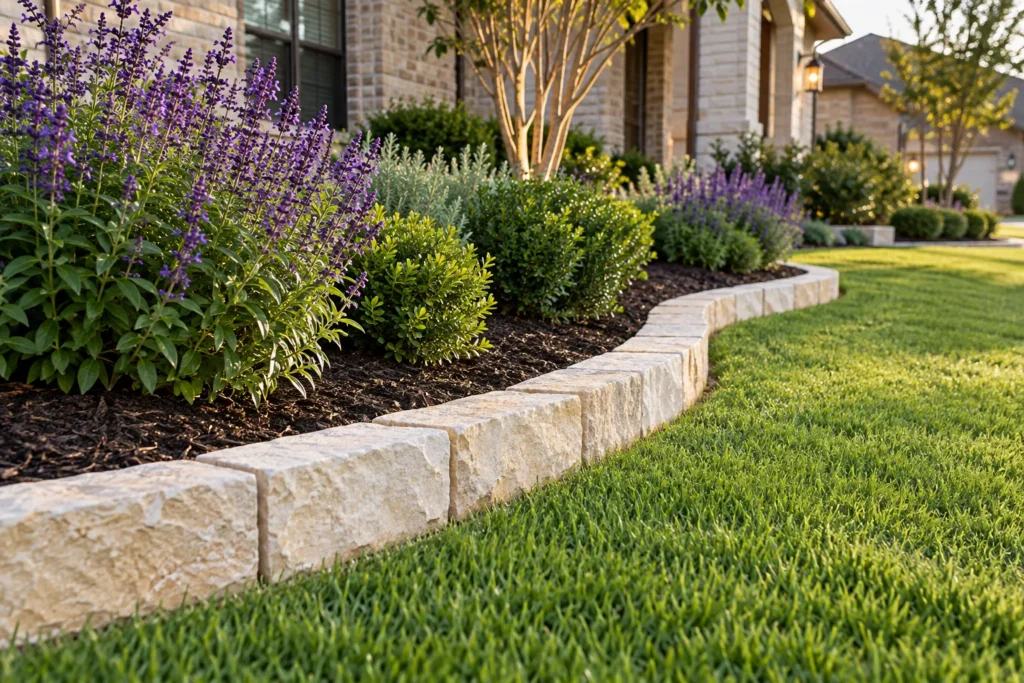
Start with how much you want the edge to stand out
Benda Board suits a relatively understated, flexible boundary; stone can make the border a more visible part of the landscape. Neither label tells you whether the proposed edge can retain soil. That question needs its own assessment.
Plano Landscaping installs Benda Board and stone borders, including Austin stone and two- or three-layer options where suitable. Decide whether the goal is a subtle lawn-to-bed line, a stronger visual frame or a change in level.
If the border needs to support raised soil, say so before selecting an edging product.

What matters beyond appearance?
| Question | Benda Board | Stone |
|---|---|---|
| Visual effect | A narrow, quieter boundary. | A visible band of material and texture. |
| Curves | Flexible product, within its specified limits. | Curve depends on selected pieces and installation. |
| Installation | Trenching, stakes and movement details matter. | Preparation, support and joint or assembly method matter. |
| Retaining soil | Not a substitute for a designed retaining structure. | Layer count alone does not establish retaining suitability. |
| Maintenance discussion | Ask about movement, exposed edges and damaged sections. | Ask about settlement, joints and matching repairs. |
| Quote comparison | Exact product, dimensions, stakes and preparation. | Stone type, layers, layout, support and finish. |
Flexible does not mean installation details are optional

Epic Plastics describes Benda Board as recycled-plastic edging designed for flexible landscape layouts. Choose the actual product and dimensions, not just a generic “plastic edging” allowance.
The manufacturer’s installation documents address support and movement details. Ask the installer how the edge will be secured and finished, especially at curves and joins.
Keep the intended function modest: a clean boundary is different from a structural wall. The manufacturer identifies non-structural use in its product guidance.
Let the material fit the house and the scale of the bed

Austin stone can tie a bed in with other light-colored stone in the yard. Look at a sample outside in your own light before choosing from a screen photo.
Ask how corners, curves and changes in level will be handled. For layered borders, discuss finished height and preparation. “Three layers” doesn’t describe the complete installation.
Our layered border guide explains how to compare two and three layers without treating a tree ring as a raised planter.
Stone choices for flower beds & tree rings
Start with a sample beside your house. Then choose the border height, curve and joint finish. These local trade names help narrow the search, but the quote should name the actual product.
Austin white / cream limestone
A light-colored border to compare beside brick, mulch and lawn. Ask for the actual white or cream selection; those names don’t guarantee matching batches.
Oklahoma chopped stone
An earth-toned option to compare for a more rustic border. Ask which Oklahoma product is quoted; the name alone doesn’t specify color, dimensions or stone type.
Lueders limestone
Compare cream and charcoal selections and sawn-and-chopped finishes. A flatter sawn face changes the look of the border; confirm which faces will remain visible.
Granbury / Milsap stone
Additional local chopped-stone choices worth sampling. Compare the current yard selection with Austin and Oklahoma before settling on its color and texture.
Illustrative samples—not exact supplier products. Compare current stock and a physical sample. JBS Express’s local chopped-stone guide covers Austin, Oklahoma, Granbury and Milsap; Whiz-Q’s product list includes cream and charcoal Lueders.
Brick colors & finishes
Compare these named paving-brick products in Acme’s catalog. Look at the color variation and texture, then review a physical sample beside your house. Joint color and laying pattern also change the finished appearance.


Product photos: Acme Brick catalog. These are supplier-listed examples, not a stock guarantee. Ask Acme’s DFW showroom about availability and physical samples. Confirm the product, intended use and installation scope with us before ordering.
A face brick, thin veneer and paving brick are not interchangeable. Confirm that the selected product suits the border, walkway or patio you are planning.
Other border choices to compare
Brick or concrete edging units give a different, more regular pattern. Steel and aluminum make a slimmer edge; flexible Benda Board works with curves. Choose an edging product intended for the job—not leftover patio material by appearance alone. A retaining wall needs its own design.
Tree rings: protect the tree first
A tree ring can define the mulch area without becoming a raised planter. Keep the trunk flare exposed, avoid adding soil over established roots, and plan installation around roots instead of cutting through them. Where a stone border would disturb roots, a simple mulch edge may be the better choice. See Extension guidance on protecting roots.
Explore stonework and bed edging →Protect the tree before choosing the ring
A border around a tree should not become an excuse to bury its base. University of Maryland Extension explains why the root flare matters and why excess soil around the trunk can be a problem.
Check where roots are before planning trenches or supports. A border drawn neatly around a tree doesn't mean it's safe to dig along that line.
A lower border that needs less digging may be a better fit. If major roots or the tree's health are involved, have the tree assessed before settling on the border.
 Consider the tree first
 Resolve standing water
Compare the same route and finish
Measure the whole border, including returns and curves. Compare removal of existing edging, disposal, preparation, materials and cleanup—not just material cost per foot.
Stone and Benda Board proposals may have different preparation and labor. Ask what is included and how existing irrigation or paving will be protected.
The edging cost guide helps organize the scope. A product price alone isn’t the installed project price.
Use a simple visual test
Look at the bed from where you usually see it. A less noticeable edge keeps attention on the plants. If you want the border to stand out, look at stone at the height you're considering.
Mark the border on the ground, then check mower access, paths and where water moves. Choose for that yard instead of deciding that one material is always best.
Compare Edging for Your Yard →Choose the edge alongside the planting and ground cover: plan the bed refresh; compare mulch and rock finishes.
Check approvals for your project
A decorative bed edge and a wall holding back soil do different jobs. Check approval requirements for the actual height, position and purpose.
Edging questions
Is Benda Board a retaining wall?
No. Treat it as non-structural edging and assess any retained-soil requirement separately.
Does more stone mean a better border?
Not necessarily. Height, preparation, roots and drainage need to fit the site.
Can either option go around trees?
Potentially, but the design must respect roots and the existing root flare.
Can I mix materials?
Yes, discuss how transitions look and function. Each section still needs suitable installation.
Sources and notes
Reviewed October 4, 2026. Epic Plastics is the primary product source; Extension supports the tree-depth discussion. Product instructions govern the selected edging. Images are illustrative, and suitability must be assessed on site.