List the chores you want to reduce
Be specific: mowing, seasonal planting, pruning, cleaning up pet areas, watering adjustments or maintaining awkward corners. A design that reduces mowing may still increase leaf removal or surface cleaning. Start with the chores that actually cause frustration.
Also identify what you enjoy. You may want to keep a small lawn, a favorite tree or a few flowering beds. A useful plan preserves those priorities rather than pursuing a maintenance-free label.
Every option has an upkeep tradeoff
| Option | May reduce | Still needs |
|---|---|---|
| Simpler planting | Repeated replacement and complicated pruning. | Establishment care and periodic maintenance. |
| Artificial turf | Mowing and some lawn-care tasks. | Debris removal, pet cleaning and condition checks. |
| Paving | Lawn area to maintain. | Cleaning, joint care and drainage attention. |
| Well-planned lawn | Awkward edges and mismatched conditions. | Irrigation, mowing and seasonal care. |
Compare the time, cost and comfort of the whole yard. A shaded seating area and a smaller lawn may solve the problem better than making the entire property one material.
Compare the work attached to each selected finish: compare mulch and rock upkeep; plan pet-turf cleaning; compare wood and composite deck care.
Simplify shapes before removing useful features

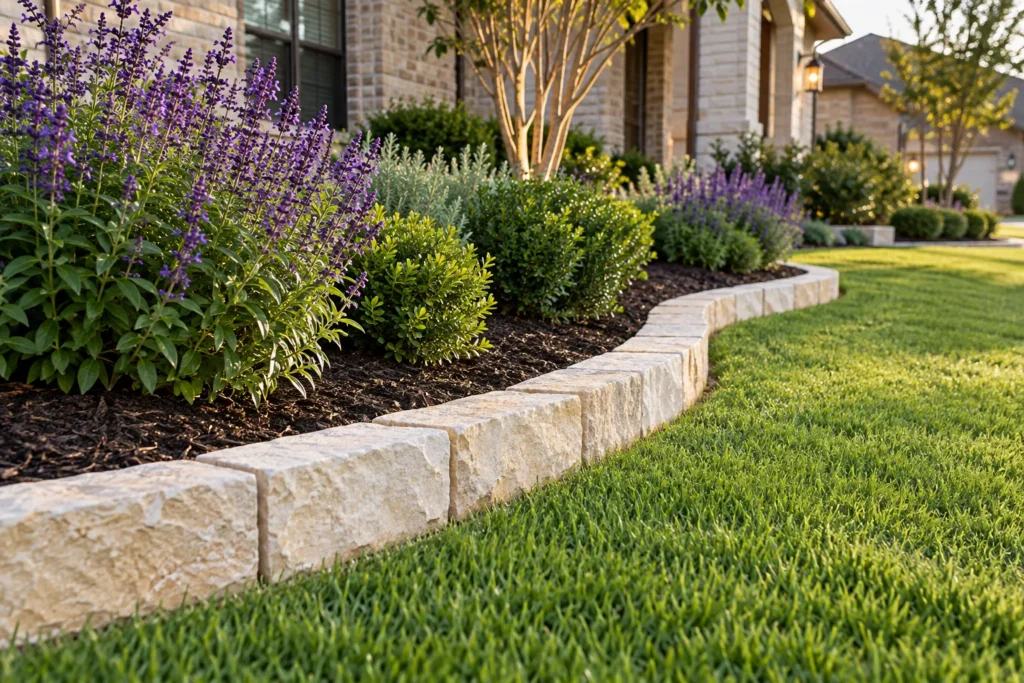
Avoid narrow strips and inaccessible corners where possible. Keep equipment access, hose points and irrigation controls reachable. Group plants with compatible needs and allow room for their mature size.
Texas A&M Earth-Kind guidance offers a locally relevant starting point for resource-conscious landscape planning. The final choices still depend on sun, soil and how you use the property.
Choose lawn or turf with the full picture
Use our turf-versus-sod comparison to consider heat, pets, water and upkeep. Artificial turf should not be sold as a solution requiring no cleaning or maintenance.
For living grass, select for the available sun and care routine. Plano Landscaping will NOT install new sod on lawns without irrigation. Irrigation installation or repairs should be planned before the sod, and the installation minimum is 450 square feet.
Our artificial turf versus sod comparison puts watering, cleaning, heat and everyday use side by side.
Make a manageable first phase
- Correct a recurring drainage or irrigation issue.
- Simplify the most difficult bed or lawn edge.
- Choose one surface or planting change with a clear purpose.
- Retain access for any later construction.
- Agree on the care required after installation.
Bring that list to an outdoor project estimate. Ask for the ongoing work as well as the installation cost to be explained.
Reserve access and future work locations while completing the first phase: plan the backyard in stages.
Find Your City’s Outdoor Living Projects Permit Resources
List each component: patio, deck, pergola, lighting, grading or other planned work. A combined project can involve more than one approval path.
What to ask about this project
Ask the city to identify the approvals for each component, including structural, electrical, flatwork and drainage work. Confirm sequencing, fees and inspection stages before choosing the construction schedule.
Find your city below. Find official resources for Plano and the DFW / North Texas communities we serve. Each city can have different rules, so check the ones that apply to your address and project.
Neighborhoods and communities
These neighborhoods use their city's resources. Check which city has authority over your property.
Confirm the address, scope and fees
Check which authority covers your property; the mailing city alone may not tell you. Dallas neighborhoods link to Dallas resources. Las Colinas and Valley Ranch link to Irving. Check boundary properties, Heartland and Hebron carefully. For Hebron, use the county-listed town contact to confirm the permitting authority. Ask who handles applications, what the current fees are, and which plans and inspections you need. HOA approval is separate from city approval.
Official resource directory maintained October 4, 2026. General links show you where to ask about permits. They don't confirm whether your work needs one. Check the current rules for your project before work begins.
Maintenance questions
Is artificial turf maintenance-free?
No. Plan cleaning, debris removal and periodic condition checks, especially with pets.
Should all grass be removed?
Not necessarily. A smaller, better-suited lawn can remain a useful part of the design.
Can irrigation be ignored in a low-maintenance yard?
No. New plants need appropriate care, and watering systems still need inspection and adjustment.
Planning reference
Texas A&M Earth-Kind supports the landscape-planning approach. This guide doesn’t promise a fixed reduction in maintenance time or water bills.